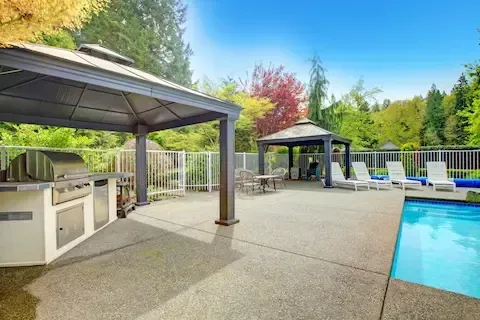
Late Summer Concrete Patio Sealing in Camas Washington
Late summer in Camas brings a narrow but valuable window for concrete patio maintenance. From roughly mid-July through September, the Pacific Northwest trades its persistent drizzle for stretches of dry, warm weather. That shift matters more than most homeowners realize when it comes to sealing concrete. Sealer needs dry, temperate conditions to bond correctly and cure fully — and the Camas area rarely offers a longer reliable stretch than this one.
Why Timing Matters for Concrete Sealing in the Pacific Northwest
Concrete sealer is not forgiving of moisture. If the surface is even slightly damp when you apply it, the sealer can trap water beneath the film, leading to a milky, cloudy finish, bubbling, or outright delamination. In western Washington, where humidity rarely drops below 60 percent outside of summer, the window for application is genuinely limited.
Late summer gives you several advantages at once. Surface temperatures are warm enough to allow the sealer to penetrate and film properly. Rain probability is low enough that you can reasonably expect 24 to 48 hours of dry conditions after application — which is what most penetrating and film-forming sealers require to set. And you still have enough daylight to work comfortably without rushing.
If you miss this window, the next safe opportunity is often not until the following summer. Fall in Camas and the broader Columbia River Gorge corridor tends to bring rain back in earnest by mid-October, sometimes earlier. Attempting to seal in October or November is a gamble most concrete professionals would not take.
Choosing the Right Sealer for a Camas Patio
Not all sealers are appropriate for outdoor concrete in this climate. There are two broad categories to understand: penetrating sealers and topical sealers.
Penetrating sealers (silane, siloxane, and silane-siloxane blends) soak into the concrete and repel water from within. They do not change the appearance of the surface and leave no film to peel or wear away. These are well-suited to Camas conditions because they handle freeze-thaw cycles and persistent moisture without failing visibly. The Columbia Gorge region does see occasional hard freezes in winter, and a good penetrating sealer helps prevent water infiltration that can cause surface spalling.
Topical sealers (acrylics, epoxies, polyurethanes) form a film on top of the concrete. They can enhance color, add sheen, and provide a degree of stain resistance. Stamped or decorative concrete patios often benefit from a topical sealer because it brings out the color and texture of the finish. However, topical sealers require more careful application and more attentive reapplication every few years as the film wears.
If you have a standard broom-finished concrete patio, a penetrating sealer applied every three to five years is usually the most practical choice. If your patio is stamped, exposed aggregate, or stained, a topical acrylic or polyurethane product makes more sense — and late summer is exactly the right time to refresh it before UV-heavy months give way to wet ones.
Preparing the Surface Before You Seal
Sealer application is only as good as the prep work underneath it. Skipping surface preparation is one of the most common reasons sealers fail prematurely.
Clean thoroughly. Remove all dirt, moss, algae, and organic debris. Power washing at appropriate pressure (not too high for older or thinner slabs) is usually the right approach. Allow the surface to dry completely — typically 24 to 48 hours in late summer Camas conditions.
Address cracks. Small hairline cracks should be cleaned and filled with a compatible concrete crack filler before sealing. Sealing over open cracks traps moisture and allows the cracks to worsen through freeze-thaw cycles.
Check for old sealer. If the patio was previously sealed, check whether the old product has failed, peeled, or is flaking. Failed topical sealers must be stripped before reapplication, or the new coat will not bond.
Test for moisture. Tape a piece of plastic sheeting to the concrete for 24 hours. If condensation forms on the underside, the slab is too damp to seal.
Application Conditions to Watch For
Even in August, Camas can throw a surprise. Morning marine layer from the Columbia River can leave concrete surfaces damp into mid-morning. Temperature inversions near the Gorge occasionally bring unexpected humidity. Before you begin sealing, confirm surface temperature is above 50°F and below 90°F, and that no rain is forecast for at least 48 hours. Check local Camas weather specifically rather than broader Portland metro forecasts — the two can diverge, especially during easterly flow events.
Avoid applying sealer in direct afternoon sun on a very hot day. Acrylic sealers in particular can dry too quickly and lap marks become visible in the finish. Early morning or late afternoon on a clear day tends to give the most workable conditions.
How Often Camas Patios Need Resealing
The Pacific Northwest climate is demanding on concrete. Rain volume, moss growth, and freeze-thaw activity all accelerate wear on both the concrete surface and any sealer protecting it. A general guideline for this region:
Penetrating sealers: every three to five years
Acrylic topical sealers: every two to three years
Polyurethane and epoxy sealers: every four to six years, depending on traffic and UV exposure
If you notice water no longer beading on the surface of a previously sealed patio, that is a reliable sign the sealer has worn and reapplication is due. Do not wait until you see surface spalling or color fading — by that point, some damage has already occurred.
Working With a Professional Versus DIY
Sealing a residential patio is a task many homeowners handle successfully on their own. The products are widely available, and the process is straightforward on a well-prepared surface. That said, professional application makes more sense in a few situations: large or complex patios, decorative concrete requiring color-matched products, surfaces with significant prior damage, or cases where previous DIY sealing attempts have left failed product that needs professional stripping.
If you are considering a new patio as part of a broader outdoor project, it is worth learning about patio installation options before committing to a sealing-only approach. In some cases, resurfacing or replacement is more cost-effective than continued maintenance of an aging slab.
For more detail on surface styles that hold up well in this region, take a look at our Camas patio designs to see what construction choices affect long-term maintenance.
Making the Most of the Dry Season
Late summer in Camas is finite. The dry stretch that makes sealing practical typically runs from late July through early September, occasionally extending into late September in favorable years. Homeowners who plan ahead — cleaning the patio, sourcing materials, and watching the forecast — are the ones who complete this maintenance in the right window. Those who wait for the perfect weekend in October often find themselves looking at rain for the next eight months.
Sealing concrete is not glamorous work, but it is one of the most cost-effective ways to extend the life of an outdoor surface in the Pacific Northwest. A properly sealed patio in Camas can resist the moss, staining, and surface deterioration that untreated concrete accumulates surprisingly fast in a wet climate. The window is open now. Use it.
One more thing to weigh before you pick a product. Read how sealer choice affects slip resistance.
